THE MUSICAL MUSE
Blog dedicated to music education, practice tips, health
&
wellness, and geeking out.

Back and Shoulder Stretches for Musicians
Many musicians complain of back and shoulder pain. Regular stretching will ease pain in the shoulder and back, increase flexibility and prevent repetitive strain injury.
Many musicians complain of back and shoulder pain. Regular stretching will ease pain in the shoulder and back, increase flexibility and prevent repetitive strain injury.
Musicians sit or stand in the same position for extended periods of time when practicing. Common complaints include:
shooting pain through the shoulder and back
dull ache in the shoulder and back
stiffness
The degree of pain varies from mild discomfort to debilitating. If unchecked, these chronic conditions can end one's musical career.
Musicians are prone repetitive strain injury such as Thoracic Outlet Syndrome, Bursitis and Tendinitis. Pain and injury in musicians stem from poor posture, faulty technique, repetitive strain and overuse. Musicians can alleviate shoulder and back pain and avoid injuries by incorporating stretching exercises into their regular routine.
How Musicians Should Stretch the Back and Shoulder Muscles
Musicians should stretch prior to practicing or performing. Stretches can be done after a shower or after performing light exercises. Musicians should take breaks frequently to stretch. For example, stretches can be done before moving onto a new technical exercise or piece or after drilling a trouble spot.
Refer to the exercises and photos below:

1 Shoulder Shrugs
Purpose: To ease shoulder tension, alleviate shoulder pain and loosen up the shoulder muscles.
Performance:
From a standing or sitting position, shrug your shoulders, drawing them up towards your ears.
Hold your shoulder muscles taut for five seconds.
Relax.
Repeat at least two more times.
2 Shoulder Blade Pinch
Purpose: To ease shoulder tension, alleviate shoulder pain and loosen up the shoulder muscles.
Performance:
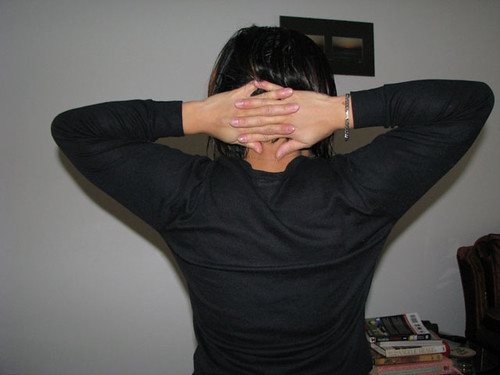
Interlock your fingers and place them behind your head. Keep your elbows straight out to the side.
Pull your shoulder blades together to produce tension in your upper back and shoulder blades.
Hold this position for five to ten seconds.
Relax.
Repeat three to four times.
3 Shoulders & Pectoral Stretch
Purpose: To ease tension in the shoulders and pectoral muscles, alleviate shoulder pain and loosen up the shoulder muscles.
Performance:
Interlace your fingers behind your back.
Slowly turn your elbows inward and straighten your arms.
Hold the stretch for five to 15 seconds.
Relax.
Repeat at least twice.
4 Prayer Stretch
Purpose: To ease tension and provide back pain relief.
Performance:
Kneel on the floor.
Reach out with both arms straight in front of you along the floor.
Lower your body onto your heels.
Hold this position for 20 - 30 seconds.
Relax.
Repeat at least twice.
5 Downward Facing Dog
Purpose: To ease tension and relieve pain in the back.
Performance:
Start on all fours.
Drop your head down.
Raise your buttocks straight up towards the ceiling while straightening out your arms and legs. Keep your heels on the floor.
Allow your spine to sink into your body and lengthen.
Hold this stretch for 20 - 30 seconds.
Relax.
Repeat at least twice.
6 Cat Stretch
Purpose: To ease tension and provide back pain relief.
Performance:
Start on all fours.
Drop your head down.
Raise your spine up between the shoulder blades while maintaining an abdominal hollow.
Allow your spine to relax.
Hold this stretch for 20 - 30 seconds.
Relax.
Repeat at least twice.
6 Standing Forward Bend
Purpose: To ease tension and relieve pain in the back.
Performance:
Stand with your feet hip-width apart.
Slowly bend forward, one vertebra at a time, allowing your head and arms to drop towards the floor.
Keep your knees soft..
Allow your spine to lengthen.
Hold this stretch for 20 - 30 seconds.
Relax.
Repeat at least twice.
7 Cross Spiral Stretch
Purpose: To ease tension and provide back pain relief.
Performance:
Lie on your back, holding your arms outstretched to the side.
Bend your right knee and bring it over to your left side towards the floor, allowing it to drop over your left leg.
Turn your head to the right.
Hold this stretch for 20 - 30 seconds.
Relax.
Switch sides.
Repeat.
For further advice, musicians should speak with a doctor, chiropractor, physical therapist or massage therapist. Alternately, musicians can take a class that involves a high degree of stretching, such as yoga.
An excellent set of stretches is outlined in Madeline Bruser's book The Art of Practicing: A Guide to Making Music from the Heart. You may also find the following articles useful: Oh, My Aching Back!, The Benefits of Yoga and How it Helps Healing, Understanding Musician Injuries.
By dedicating as little as five minutes a day to stretching, musicians can ease shoulder pain, treat back pain and prevent musician injuries.

Arm and Hand Stretches for Musicians
Many musicians complain of numbness and pain in the hand, forearm and arm. They can prevent repetitive strain injury, ease pain and tension by stretching regularly.
Many musicians complain of numbness and pain in the hand, forearm and arm. They can prevent repetitive strain injury, ease pain and tension by stretching regularly.
By nature, learning music involves repeating until a passage or technical exercise until a high level of proficiency, fluency and artistry is achieved. Instrumentalists use their finger, hand and arm muscles extensively when practicing and performing. This makes them especially vulnerable to a repetitive stain injury such as Carpal Tunnel Syndrome, Bursitis and Tendinitis. Musicians can ease arm and hand pain, relieve tension and prevent injuries by incorporating stretching exercises into their daily routine.
How Musicians Should Stretch the Hand and Arm Muscles
Stretching exercises should be done when the muscles are warm. For example, stretches can be done after a shower, after a bath or after performing some light exercises. Musicians should always stretch prior to practicing. They should also take regular breaks when practicing to stretch. For example, stretches can be done before switching to a new piece or after practicing a physically challenging section of music. Musicians should also stretch prior to performing and in between performances.
Stretching Exercises for Musicians
Follow the arm and hand exercises and refer to the photos below:
1 Finger Flicks
Purpose: Prevent Tendinitis and Trigger Finger, relieve tension and increase blood circulation in the hands.


Performance:
Hold your hands in a loose fist in front of you.
Flick your fingers so that your fingers are outstretched. Pretend that you are flicking water.
Hold your fingers in an outstretched position for 10 seconds.
Relax.
Repeat.
2 Wrist Circles
Purpose: Prevent Tendinitis, relieve tension and increase blood circulation in the wrists.
Hold your hands in a loose fist in front of you.
Rotate your wrists in a circle several times in one direction.
Relax.
Rotate your wrists in a circle in the other direction.
Relax.
Variation: Sticking out your thumb as if you were hitchhiking.
3 Fingers Interlaced Wrist Circles
Purpose: Prevent Tendinitis, relieve tension and increase blood circulation in the wrists.
Interlace your fingers together in front of you. Keep track of which thumb is resting on top.
Rotate your wrists in a circle several times in one direction. Start slowly and as you get more comfortable, increase the speed.
Relax.
Reposition your hands so that the opposite thumb is resting on top.
Rotate your wrists in a circle in the other direction.
Relax.
4 Forearm Flexor Stretch
Purpose: Prevent Tendinitis in the elbow and forearm, relieve tension and increase blood circulation.

Performance:
Place your hands together in a praying position.
Push your hands together and push your arms downward until you feel a gentle stretch.
Hold the stretch for 10 - 20 seconds.
Relax.
Repeat at least once.

5 Single Arm Forearm Flexor Stretch
Purpose: Prevent Tendinitis in the elbow and forearm, relieve tension and increase blood circulation.Performance:
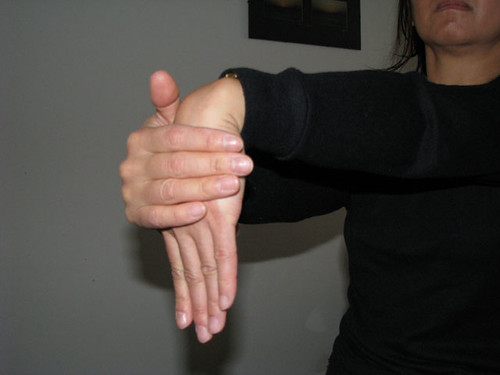
Hold your left arm straight in front of you with your palm facing forward as if to indicate "stop".
Brace your left palm with your right hand.
Gently pull the fingers in your left hand towards you until you feel a gentle stretch.
Hold for 10 - 20 seconds.
For a deeper, isometric stretch, push your left arm forward, into your right hand, as you pull your left hand towards you.
Relax.
Repeat with the opposite arm.
6 Forearm Extensor Stretch
Purpose: Prevent Tendinitis in the elbow and forearm, relieve tension and increase blood circulation.Performance:
Extend your left arm in front of you, holding your arm straight.
Let your hand flop downward at the wrist.
Place your right palm over your left hand (above the fingers).
Gently push your left hand towards you with your right hand until you feel a gentle stretch.
Hold for 10 - 20 seconds.
For a deeper, isometric stretch, push your left arm forward, into your right hand, as you pull your left hand towards you.
Relax.
Repeat with the opposite arm.
7 Soup Can Forearm Extensor Exercise
Purpose: Prevent Tendinitis in the elbow and forearm, relieve tension and increase blood circulation.
Performance:
With your right forearm on a table and let your right hand flop down.
Place a soup can in your right hand.
Beginning with your wrist level with your forearm, slowly let your hand point downward until you feel a gentle stretch in your forearm extensors.
Hold for 10 seconds.
Steadily raise your hand so that your wrist is level with your forearm.
Relax.
Complete 10 repetitions.
Repeat the exercises with the opposite arm.
8 Tricep Stretch
Purpose: Prevent Tendinitis in the elbow and upper arm, relieve tension and increase blood circulation.
Performance:
Hold your left elbow with your right hand.
Gently pull your left arm towards you until you feel a gentle stretch.
Hold for 10 - 20 seconds.
Relax.
Stretch the right arm.
Repeat this stretch at least once.
Never stretch to the point of pain. Strive for a gentle stretch. If you are already suffering from a repetitive strain injury, consult a doctor, chiropractor, physiotherapist or registered massage therapist (licensed in therapeutic massage) before attempting these exercises.
By spending as little as five minutes a day on stretching exercises, musicians can alleviate symptoms of carpal tunnel syndrome, prevent tendinitis. This can lead to many years of healthy and pain-free years of music-making.
You may find more information through these links: Benefits of Stretching, Face and Neck Stretches for Musicians, The Art of Practicing, Understanding Musician Injuries, Simple Exercises to Strengthen the Wrists and Wrist Exercises.

Face and Neck Stretches for Musicians
Doing regular neck and face stretching exercises improves musician health, leading to increased flexibility, dexterity, coordination and blood circulation.
Doing regular neck and face stretching exercises improves musician health, leading to increased flexibility, dexterity, coordination and blood circulation. Musicians are prone to injuries stemming from tension, poor posture, improper technique, repetitive strain and overuse. All musicians use their facial and neck muscles extensively, making them susceptible to Temporomandibular Joint (TMJ) Dysfunction and Thoracic Outlet Syndrome. These injuries can be prevented by incorporating stretching exercises for musicians into their daily routine.
How Musicians Should Stretch the Face and Neck Muscles
Musicians should stretch prior to practicing or performing. They should be done after the muscles have had a chance to warm up. For example, stretches can be done in the shower, after a shower or after doing some light exercises.
Musicians should take breaks during practice sessions to stretch. After drilling a “trouble spot” numerous times, it is advisable to do some stretches before tackling a new section or piece. Stretching backstage between performances is also beneficial.
Follow these seven exercises and refer to the photos below:

1 Big Mouth Stretch
Purpose: Loosen up the jaw muscles, increase blood circulation and help prevent TMJ Dysfunction.
Performance:
Begin with your head level and facing forward.
Sit in a comfortable position.
Breathe in, raise your eyebrows and open your mouth wide as wide as possible.
Close your mouth after exhaling while keeping your jaw centered.
Hold stretch for 5 – 10 seconds. Repeat up to 10 times.

2 The Squinch
Purpose: Increase blood flow and relax the muscles in the face and jaw.
Performance:
Begin with your head level and facing forward.
Sit in a relaxed position.
Exhale and “squinch” or “scrunch” your entire face.
Hold this position for three seconds then relax.
Repeat.

3 Isometric Jaw Exercise
Purpose: To relax the jaw muscles.
Performance:
Begin with your head level and facing forward.
Make a fist and place it directly underneath your chin.
As you slowly open your jaw, provide some resistance by gently pushing your fist upwards.
Hold this position for 10 seconds.
Release.
Repeat 10 times.
4 Lip Flutters
Purpose: Strengthen vocal folds and relax facial muscles.
Performance:
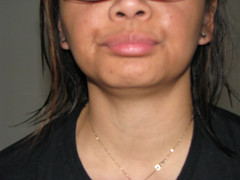
Keep your teeth slightly open, lips a little bit forward and face soft.
Take a low breath from the diaphragm.
Pretend to blow a bubble and allow the air in your lungs to make your lips vibrate.
Try to sustain the sound for as long as possible, until you run out of air.
Don’t pucker your lips.
Gently place your fingers on either side of your mouth if you are having trouble.
Repeat several times, trying the following variations: lip flutters without sound, staccato lip spurts without sound, lip flutters with sound (try to imitate a small motor purring), pitched lip flutters (flutter your lips while vocalizing a scale or a song).

5 Side Neck Stretch
Purpose: Relaxes your neck and shoulder muscles.
Performance:
Begin with your head level and facing forward.
Slowly tilt your head towards the right ear to stretch the left side.
Hold the stretch between 10 – 20 seconds.
Repeat, stretching the right side.
Stretch both sides at least two more times.
6 Front to Back Neck Stretch
Purpose: Relieves tension in your head, neck, back, hips and shoulders.
Performance:
Begin with your head level and facing forward.
Imagine that there is a small ball tucked under your chin.
Gently tilt your head downward, being mindful of your imaginary ball.
Hold this stretch for 5 – 10 seconds.
Repeat up to five times.
7 Side to Chin Neck Stretch
Purpose: Provides pain relief in your head, neck, back, hips and shoulders.
Performance:
Begin with your head level and facing forward.
Slowly tilt your head towards the right ear to stretch the left side.
Gently turn your chin downward towards your shoulder.
Hold the stretch between 10 – 20 seconds.
Repeat, stretching the right side.
Stretch both sides at least two more times.
Strive for a gentle stretch. Never stretch to the point of feeling pain. If your jaw makes any clicking or popping sounds when you open and close your jaw, consult a dentist before trying these exercises. Seek professional help from a doctor, physiotherapist or chiropractor if you need further guidance.
Dedicating as little as five minutes a day to stretching will ease tension, relieve jaw pain, ease neck pain and increase flexibility in musicians. If done regularly with proper technique, musicians can enjoy many years of pain-free and injury-free music-making.
Related Articles
Understanding Musician Injuries | Arm and Hand Stretches | Back and Shoulder Stretches
The Art of Practicing | Musician's Yoga: A Guide to Practice, Performance, and Inspiration | | Playing (Less) Hurt: An Injury Prevention Guide for Musicians
Understanding Musician Injuries
The Types, Causes and Prevention of Music-Related Injuries: Musicians are prone to injury from repeating a motion countless times when practicing. A better understanding of music injuries is vital for musicians' health.
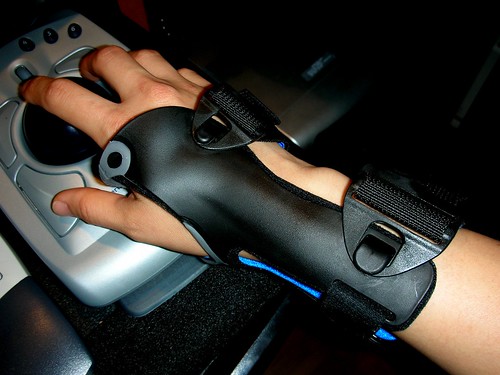
Musicians are prone to injury from repeating a motion countless times when practicing. A better understanding of music injuries is vital for musicians' health.
Common symptoms of a musician repetitive strain injury are similar to computer-related and speech-related injuries:
Numb fingers, arms, wrist, jaw, neck, shoulders and back
Shooting pain up the arms, shoulder and back
Cramping muscles or stiffness
Dull ache experienced in the fingers, arms, back, jaw, throat, wrist, shoulders and back
Hoarseness
If left unchecked, can become chronic conditions. They can potentially lead to long-term disability or end one’s musical career.
Common Types of Music Injuries
Common music-related injuries include:
Bursitis: inflammation of a bursa (fluid-filled sac which lubricates the movements of tendons, muscles and bones at joints)
Carpal Tunnel Syndrome: inflamed or irritated hand flexor tendons
Larynx Contact Ulcers: raw sores on the mucous membranes covering the cartilage attached to the vocal chords
Cubital Tunnel Syndrome: inflamed or irritated tendons affecting the inner side of the forearm and the pinky side of the hand
Laryngitis: inflammation of the larynx
De Quervain's Tenosynovitis: inflammation of the tendons on the side of the wrist beginning at the base of the thumb.
Tendinitis: inflammation of the tendons
Thoracic Outlet Syndrome: compression of the thoracic outlet, the nerve pathway and/or blood vessels between the base of the neck and the armpit
Trigger Finger: inflammation of the index finger tendons
Vocal Nodules & Polyps: small, inflammatory or fibrous growth on the vocal cords of people who strain their voices.
How Music Injuries are Caused
Overuse: Advanced musicians practice between one to ten hours a day.
Repetitive Strain: Musicians repeat a technical exercise or section of music countless times until it comes together.
Improper Posture: Some musicians slouch, sit too close or too far from their instrument and remain in the same position for long periods of time.
Non-Ergonomic Technique: Some musicians hold their body and/or instrument in an uncomfortable position, don’t move their hand and/or body in the direction that their fingers are moving, push their fingers or vocal chords beyond what they can comfortably do.
How to Prevent Music Injuries
Do Your Research: Find out more about the various types of music-related injuries.
Assess Your Instrument: Is your instrument the right size, shape, weight and height for you? Would an adjustable chair, footstool, strap or cushion make you more comfortable?
Know Your Body: Choose pieces that are reasonable for your body to play. If you have small fingers, playing repertoire that requires you to stretch beyond your finger span is a recipe for disaster. However, if you really want to learn a particular piece (or you need to learn it), make adjustments to make it easier to play. If you are a student, let your teacher know right away whether a piece or technical exercise is causing you pain.
Appraise Your Playing Technique: Is your body relaxed? Are your hands, arms, neck, head and core positioned to allow for fluid and comfortable playing or singing? Are you moving with the music? Are you using excess movements? Is your fingering logical and comfortable? Videotaping yourself is a valuable method to assess your playing technique.
Evaluate Your Non-Musical Activities: Desk and computer work, sports, dancing, carrying heavy objects (or dependents) and hobbies can adversely affect your body.
Do Warm-Up Exercises and Stretches: Musicians are sometimes called “small muscle athletes”. Stretching exercises and gentle warm-ups result in increased range of motion, strength, coordination and flexibility.
Take Breaks: One’s muscles, ears and vocal chords need regular breaks to return to their relaxed state. Not doing so tricks the body into thinking that “tense” is the “relaxed state”, resulting in chronic pain and stress.
Engage in Active Sitting: Most musicians remain in a seated position for extended periods of time. Active seating helps ease chronic back pain, promotes correct posture and maintains general health.
Seek Professional Advice: Speak to a doctor, chiropractor, massage therapist, Alexander Technique specialist, music instructor, otolaryngologist or ergonomic specialist for further information or treatment.
Be Proactive in Maintaining Musician Health
With an increased understanding of the types, causes and prevention of music injuries, musicians can be more proactive in maintaining their first instrument: the body. Musicians dedicated to maintaining musician health can look forward to many years of pain and injury-free music-making.
The Rest of My Series on Musician Injuries
Face and Neck Stretches for Musicians | Arm and Hand Stretches for Musicians | Back and Should Stretches for Musicians
Additional References:

The Art of Practicing: A Guide to Making Music from the Heart, Madeline Bruser (New York: Bell Tower, 1999)
Musicians' Injuries: Types and How to Avoid It, Espie Estrella
Musicians and Injuries, UN-L Engineering Electronics Shop, University of Nevada
Originally published on Suite101.com on November 20, 2009. All rights reserved by Rhona-Mae Arca.

Music Practicing 101 - Finger Push Ups
This finger exercise is one I learned at one of my early piano lessons, many moons ago. It's a hand exercise to strengthen those musical fingers, especially our very weak finger #4.
This finger exercise is one I learned at one of my early piano lessons, many moons ago. It's a hand exercise to strengthen those musical fingers, especially our very weak finger #4.
I detested it during those early piano practices, but I must say, my Finger #4's are better because of it. My students and I have dubbed it "Finger Push Ups":
Social Media Links
archives
- #YYCArts 32
- #YYCEvents 39
- Collaborative Music 25
- Community 11
- Composing & Arranging 6
- Entertainment 139
- Entrepreneurship 53
- Freebies 3
- Gardening 1
- Geeking Out 65
- Health & Wellness 120
- Improvisation 25
- Interviews 28
- Learning Music 188
- Martial Arts 13
- Memorization 7
- Music 230
- Music Careers 9
- Music Education 196
- Music Examinations 7
- Music Exploration 55
- Music Gigs 14
- Music Lessons 6
- Music Performance 32
- Music Theory 13
- Musical Instruments 12
- Musician Health 19
- Pets 57
- Piano Technique 12
- Practicing Music 120
- Productivity 20
- Professional Development 11
- Recommendations & Reviews 93
- Recreation 71
- Social Media 6
- Spirituality 10
- Studio Management 33
- Studio Technology 50
- Teaching Music 146
FOLLOW THE STUDIO on Instagram


Affiliate Links
As a Sheetmusicplus and CD Japan affiliate, I earn from qualifying purchases. The earnings help fund the Studio’s blog and YouTube channels. Your support is greatly appreciated.


FOLLOW Budo no Tabi on Instagram