THE MUSICAL MUSE
Blog dedicated to music education, practice tips, health
&
wellness, and geeking out.
Popular Hand Exercises Books for Piano
If you or your piano teacher have decided that you add finger strengthening exercises into your at-home practice sessions, check out these popular books of finger exercises. Please note, this list is just for piano. I'll eventually get around to posting popular exercise books for the other instruments.
Regardless of your playing level, or whether you are preparing for a piano exam, finger exercises are one of the keys to achieving technical fluency. These finger strengthening exercises give you the chops you need to tackle your pieces (AKA "repertoire").
This is a list of 15 of the most popular books of finger exercises for piano. If you click on the link, you'll go to a page to order it (or get more information on it):
Piano Essentials: Scales, Chords, Arpeggios, and Cadences for the Contemporary Pianist (Book & CD)
The First Book of Scales, Chords, Arpeggios & Cadences (Alfred's Basic Piano Library)
Master School of Virtuoso Piano Playing: Volume I Finger Exercises (Dover Music for Piano)
Oscar Peterson - Jazz Exercises, Minuets, Etudes & Pieces for PianoMaster School of Virtuoso Piano Playing: Volume I Finger Exercises (Dover Music for Piano)
Burgmuller, Czerny & Hanon: 32 Piano Studies for Technique and Musicality: 1
Twenty-Five Easy and Progressive Studies for the Piano, Op. 100: Piano Solo
Hanon: The Virtuoso Pianist (Complete) (Alfred Masterwork Edition)
Your eyes aren't deceiving you. There are several different editions of Hanon's exercises - all of them are pretty popular.

Arm and Hand Stretches for Musicians
Many musicians complain of numbness and pain in the hand, forearm and arm. They can prevent repetitive strain injury, ease pain and tension by stretching regularly.
Many musicians complain of numbness and pain in the hand, forearm and arm. They can prevent repetitive strain injury, ease pain and tension by stretching regularly.
By nature, learning music involves repeating until a passage or technical exercise until a high level of proficiency, fluency and artistry is achieved. Instrumentalists use their finger, hand and arm muscles extensively when practicing and performing. This makes them especially vulnerable to a repetitive stain injury such as Carpal Tunnel Syndrome, Bursitis and Tendinitis. Musicians can ease arm and hand pain, relieve tension and prevent injuries by incorporating stretching exercises into their daily routine.
How Musicians Should Stretch the Hand and Arm Muscles
Stretching exercises should be done when the muscles are warm. For example, stretches can be done after a shower, after a bath or after performing some light exercises. Musicians should always stretch prior to practicing. They should also take regular breaks when practicing to stretch. For example, stretches can be done before switching to a new piece or after practicing a physically challenging section of music. Musicians should also stretch prior to performing and in between performances.
Stretching Exercises for Musicians
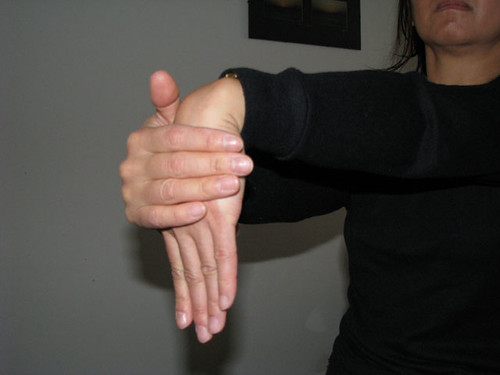
Follow the arm and hand exercises and refer to the photos below:
1 Finger Flicks
Purpose: Prevent Tendinitis and Trigger Finger, relieve tension and increase blood circulation in the hands.


Performance:
Hold your hands in a loose fist in front of you.
Flick your fingers so that your fingers are outstretched. Pretend that you are flicking water.
Hold your fingers in an outstretched position for 10 seconds.
Relax.
Repeat.
2 Wrist Circles
Purpose: Prevent Tendinitis, relieve tension and increase blood circulation in the wrists.
Hold your hands in a loose fist in front of you.
Rotate your wrists in a circle several times in one direction.
Relax.
Rotate your wrists in a circle in the other direction.
Relax.
Variation: Sticking out your thumb as if you were hitchhiking.
3 Fingers Interlaced Wrist Circles
Purpose: Prevent Tendinitis, relieve tension and increase blood circulation in the wrists.
Interlace your fingers together in front of you. Keep track of which thumb is resting on top.
Rotate your wrists in a circle several times in one direction. Start slowly and as you get more comfortable, increase the speed.
Relax.
Reposition your hands so that the opposite thumb is resting on top.
Rotate your wrists in a circle in the other direction.
Relax.
4 Forearm Flexor Stretch
Purpose: Prevent Tendinitis in the elbow and forearm, relieve tension and increase blood circulation.

Performance:
Place your hands together in a praying position.
Push your hands together and push your arms downward until you feel a gentle stretch.
Hold the stretch for 10 - 20 seconds.
Relax.
Repeat at least once.

5 Single Arm Forearm Flexor Stretch
Purpose: Prevent Tendinitis in the elbow and forearm, relieve tension and increase blood circulation.Performance:
Hold your left arm straight in front of you with your palm facing forward as if to indicate "stop".
Brace your left palm with your right hand.
Gently pull the fingers in your left hand towards you until you feel a gentle stretch.
Hold for 10 - 20 seconds.
For a deeper, isometric stretch, push your left arm forward, into your right hand, as you pull your left hand towards you.
Relax.
Repeat with the opposite arm.
6 Forearm Extensor Stretch
Purpose: Prevent Tendinitis in the elbow and forearm, relieve tension and increase blood circulation.Performance:
Extend your left arm in front of you, holding your arm straight.
Let your hand flop downward at the wrist.
Place your right palm over your left hand (above the fingers).
Gently push your left hand towards you with your right hand until you feel a gentle stretch.
Hold for 10 - 20 seconds.
For a deeper, isometric stretch, push your left arm forward, into your right hand, as you pull your left hand towards you.
Relax.
Repeat with the opposite arm.
7 Soup Can Forearm Extensor Exercise
Purpose: Prevent Tendinitis in the elbow and forearm, relieve tension and increase blood circulation.
Performance:
With your right forearm on a table and let your right hand flop down.
Place a soup can in your right hand.
Beginning with your wrist level with your forearm, slowly let your hand point downward until you feel a gentle stretch in your forearm extensors.
Hold for 10 seconds.
Steadily raise your hand so that your wrist is level with your forearm.
Relax.
Complete 10 repetitions.
Repeat the exercises with the opposite arm.
8 Tricep Stretch
Purpose: Prevent Tendinitis in the elbow and upper arm, relieve tension and increase blood circulation.
Performance:
Hold your left elbow with your right hand.
Gently pull your left arm towards you until you feel a gentle stretch.
Hold for 10 - 20 seconds.
Relax.
Stretch the right arm.
Repeat this stretch at least once.
Never stretch to the point of pain. Strive for a gentle stretch. If you are already suffering from a repetitive strain injury, consult a doctor, chiropractor, physiotherapist or registered massage therapist (licensed in therapeutic massage) before attempting these exercises.
By spending as little as five minutes a day on stretching exercises, musicians can alleviate symptoms of carpal tunnel syndrome, prevent tendinitis. This can lead to many years of healthy and pain-free years of music-making.
You may find more information through these links: Benefits of Stretching, Face and Neck Stretches for Musicians, The Art of Practicing, Understanding Musician Injuries, Simple Exercises to Strengthen the Wrists and Wrist Exercises.
A Look at Chord Helps
A look at four tools that I have come across in my attempt to help my piano students understand chords, key signatures and the Circle of Fifths better.

Most of my students are visual-aural or visual-kinesthetic learners. Needless to say, cracking open their music theory workbook is not their idea of a good time. Therefore, I'm always on the lookout for tools that "speak" more to their learning styles.
The following are four tools that I have come across in my attempt to help my piano students understand chords and the Circle of Fifths better:
Walrus Productions Piano Chords Mini-Chart


This Piano Chord Mini Chart is ideal for the visual learner. There is a piano keyboard on top to help music students with music theory. It's made of bendable plastic. I suppose one could use it as a place-mat or mouse pad if they are so inclined.
Each row contains the major, minor, dominant seventh, augmented and diminished chords starting on a particular note. The red dots show how to build each chord. If a student is still unsure of their note names, the keyboard at the top of the chart can help clear things up for them.
Is it complete? No. It just gives those basic chord types. It would have been nice if it had diminished seventh chords as well. The reverse side could have been utilized to show the Circle of Fifths and perhaps some common chord progressions.
The Piano Chords Mini-Chart runs for approximately $2.68 USD on Amazon. I purchased mine at my local Long & McQuade for $5.08 CAD.
Alfred Publishing Keyboard Chord Chart
With over 100 chords, this Keyboard Chord Chart boasts a more complete collection. What I like about this chart over the previous one is that it gives presents the information in two different ways: first, you see what the chord looks like on the staff. Then, it shows how to build the chord on the piano. However, it goes one step beyond but showing the letter names on the keys. There is a section that covers the inversion of chords as well.
It retails for approximately $3.50 USD and $3.59 CAD. One of my colleagues has a gigantic, wall-sized version of this chart.
The Pocket Idiot's Guide to Piano Chords
This 183-page pocket-book was written by my colleague Karen Berger. We "met" when we freelanced together at Suite101.com.
The Pocket Idiot's Guide to Piano Chords is more expensive than the two options I listed above. However, it offers so much more. There's a section on keyboard geography, note reading 101, building chords, advanced chords and more. It has a user rating of 4/5 stars on Amazon.
It retails for $12.95 USD and approximately $13.24 CAD. I don't have this handy book in my professional library. However, I do mean to pick one up in the near future.
The Chord Wheel
I picked up The Chord Wheel: The Ultimate Tool for All Musicians at the advice of one of the associates at Long & McQuade. It's colourful, I'll grant you that. Between the rainbow colours and the spinning wheel, it captures the attention of most of my students whenever it is out.
When you open it up, you'll see a section on analyzing chord progressions, transposition and composition. It gives some handy tips on figuring out the key signature to a song by looking at the chords listed (provided that you are looking at a fake book or P/V/G book).
It also covers scales, chords, modes and relative minors and gives ideas on what chords to use for songwriting. Sounds good, doesn't it?
However, it's not something I'd recommend for my younger students, or even my tween students who are struggling with music theory to begin with. The explanations go right over their head.
It's not piano-centric, so it is useful for vocalists, guitarists and other instrumentalists. The text is tailored towards the older learner, high school to adult.
The Chord Wheel ranks consistently in the Top 50 of Amazon's Best Seller List for Music Theory aids with a 4/5 star rating. It is the most expensive aid on this list, retailing at $14.99 USD and $15.33 CAD.
Time Saving Technique Practice Idea
Are you stuck between studying for tests and logging in much needed time on practicing technique? Try this idea that came up during one of my lessons last week.
Are you stuck between studying for tests and logging in much needed time on practicing technique? Try this idea that came up during one of my lessons last week:
This student is working on his Grade 8 piano technique. Four octave scales - woohoo?
He played d harmonic minor for the first octave and d melodic minor for the second by accident. Then, I had him play D major for the first octave, d natural minor for the second octave...you get the idea.
Basically in one pass, you practice all the scales you need to know for a traditional music exam. However, to actually hear any improvement, you'll have to play it this way more than once. More than twice.
You can change things up of course. Try this on all the minors (natural, harmonic, melodic, jazz). Or be bold and try these on some of the jazz scales.
The bottom of the white board refers to an idea I think has already been mentioned. Play the ascending scale one way (e.g., major), and the descending scale another way (e.g. harmonic minor).
You have to be awake to do this kind of practice. Well really, we should be all striving for mindful practice anyway...right?

Face and Neck Stretches for Musicians
Doing regular neck and face stretching exercises improves musician health, leading to increased flexibility, dexterity, coordination and blood circulation.
Doing regular neck and face stretching exercises improves musician health, leading to increased flexibility, dexterity, coordination and blood circulation. Musicians are prone to injuries stemming from tension, poor posture, improper technique, repetitive strain and overuse. All musicians use their facial and neck muscles extensively, making them susceptible to Temporomandibular Joint (TMJ) Dysfunction and Thoracic Outlet Syndrome. These injuries can be prevented by incorporating stretching exercises for musicians into their daily routine.
How Musicians Should Stretch the Face and Neck Muscles
Musicians should stretch prior to practicing or performing. They should be done after the muscles have had a chance to warm up. For example, stretches can be done in the shower, after a shower or after doing some light exercises.
Musicians should take breaks during practice sessions to stretch. After drilling a “trouble spot” numerous times, it is advisable to do some stretches before tackling a new section or piece. Stretching backstage between performances is also beneficial.
Follow these seven exercises and refer to the photos below:

1 Big Mouth Stretch
Purpose: Loosen up the jaw muscles, increase blood circulation and help prevent TMJ Dysfunction.
Performance:
Begin with your head level and facing forward.
Sit in a comfortable position.
Breathe in, raise your eyebrows and open your mouth wide as wide as possible.
Close your mouth after exhaling while keeping your jaw centered.
Hold stretch for 5 – 10 seconds. Repeat up to 10 times.

2 The Squinch
Purpose: Increase blood flow and relax the muscles in the face and jaw.
Performance:
Begin with your head level and facing forward.
Sit in a relaxed position.
Exhale and “squinch” or “scrunch” your entire face.
Hold this position for three seconds then relax.
Repeat.

3 Isometric Jaw Exercise
Purpose: To relax the jaw muscles.
Performance:
Begin with your head level and facing forward.
Make a fist and place it directly underneath your chin.
As you slowly open your jaw, provide some resistance by gently pushing your fist upwards.
Hold this position for 10 seconds.
Release.
Repeat 10 times.
4 Lip Flutters
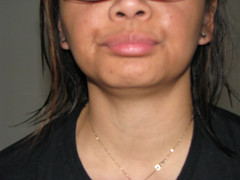
Purpose: Strengthen vocal folds and relax facial muscles.
Performance:
Keep your teeth slightly open, lips a little bit forward and face soft.
Take a low breath from the diaphragm.
Pretend to blow a bubble and allow the air in your lungs to make your lips vibrate.
Try to sustain the sound for as long as possible, until you run out of air.
Don’t pucker your lips.
Gently place your fingers on either side of your mouth if you are having trouble.
Repeat several times, trying the following variations: lip flutters without sound, staccato lip spurts without sound, lip flutters with sound (try to imitate a small motor purring), pitched lip flutters (flutter your lips while vocalizing a scale or a song).

5 Side Neck Stretch
Purpose: Relaxes your neck and shoulder muscles.
Performance:
Begin with your head level and facing forward.
Slowly tilt your head towards the right ear to stretch the left side.
Hold the stretch between 10 – 20 seconds.
Repeat, stretching the right side.
Stretch both sides at least two more times.
6 Front to Back Neck Stretch
Purpose: Relieves tension in your head, neck, back, hips and shoulders.
Performance:
Begin with your head level and facing forward.
Imagine that there is a small ball tucked under your chin.
Gently tilt your head downward, being mindful of your imaginary ball.
Hold this stretch for 5 – 10 seconds.
Repeat up to five times.
7 Side to Chin Neck Stretch
Purpose: Provides pain relief in your head, neck, back, hips and shoulders.
Performance:
Begin with your head level and facing forward.
Slowly tilt your head towards the right ear to stretch the left side.
Gently turn your chin downward towards your shoulder.
Hold the stretch between 10 – 20 seconds.
Repeat, stretching the right side.
Stretch both sides at least two more times.
Strive for a gentle stretch. Never stretch to the point of feeling pain. If your jaw makes any clicking or popping sounds when you open and close your jaw, consult a dentist before trying these exercises. Seek professional help from a doctor, physiotherapist or chiropractor if you need further guidance.
Dedicating as little as five minutes a day to stretching will ease tension, relieve jaw pain, ease neck pain and increase flexibility in musicians. If done regularly with proper technique, musicians can enjoy many years of pain-free and injury-free music-making.
Related Articles
Understanding Musician Injuries | Arm and Hand Stretches | Back and Shoulder Stretches
The Art of Practicing | Musician's Yoga: A Guide to Practice, Performance, and Inspiration | | Playing (Less) Hurt: An Injury Prevention Guide for Musicians
Social Media Links
archives
- #YYCArts 32
- #YYCEvents 39
- Collaborative Music 25
- Community 11
- Composing & Arranging 6
- Entertainment 139
- Entrepreneurship 53
- Freebies 3
- Gardening 1
- Geeking Out 65
- Health & Wellness 120
- Improvisation 25
- Interviews 28
- Learning Music 188
- Martial Arts 13
- Memorization 7
- Music 230
- Music Careers 9
- Music Education 196
- Music Examinations 7
- Music Exploration 55
- Music Gigs 14
- Music Lessons 6
- Music Performance 32
- Music Theory 13
- Musical Instruments 12
- Musician Health 19
- Pets 57
- Piano Technique 12
- Practicing Music 120
- Productivity 20
- Professional Development 11
- Recommendations & Reviews 93
- Recreation 71
- Social Media 6
- Spirituality 10
- Studio Management 33
- Studio Technology 50
- Teaching Music 146
FOLLOW THE STUDIO on Instagram


Affiliate Links
As a Sheetmusicplus and CD Japan affiliate, I earn from qualifying purchases. The earnings help fund the Studio’s blog and YouTube channels. Your support is greatly appreciated.


FOLLOW Budo no Tabi on Instagram