THE MUSICAL MUSE
Blog dedicated to music education, practice tips, health
&
wellness, and geeking out.
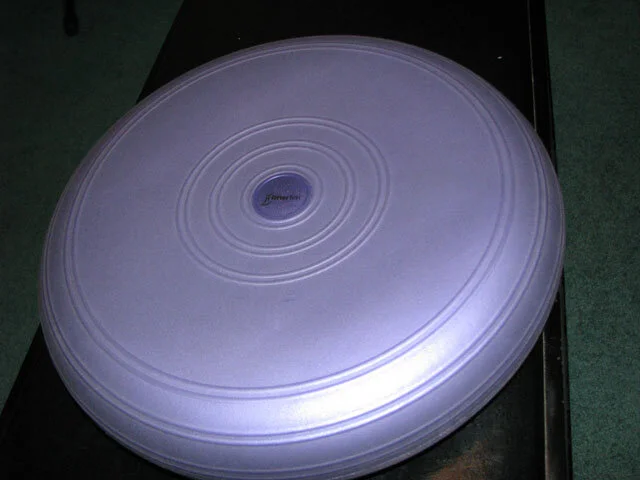
Product Review: FitBall Seating Disc
The average person sits 56 hours a week, leading to sitting fatigue, chronic pain and poor posture. Wiggle your way to better health with the FitBall Seating Disc.
The average person sits 56 hours a week, leading to sitting fatigue, chronic pain and poor posture. Wiggle your way to better health with the FitBall Seating Disc.
On December 11, 2009, Fox News reported on a study which stated the average American spends 56 hours a week sitting. In Sitting Too Much?, Seline Yager states that oversitting has detrimental effects, from obesity to heart disease, and from diabetes to chronic pain stemming from improper posture.
Active sitting involves constantly adjusting your body position while seated. Fitterfirst, a manufacturer and supplier of active seating devises, state the benefits as being:
improved core stability
mild exercise (burn up to 350 calories a day from active sitting)
ergonomic seating
improved balance
improved body posture and spinal alignment
increased blood flow
decreased stiffness
pain relief
Who Can Use the FitBall Seating Disc
Anyone who sits for long periods of time will benefit from using the FitBall Seating Disc, from office workers to truck drivers, from musicians to painters and from students to seniors. People who wish to improve their posture can use the FitBall Seating Disc.
In "Effects of Stability Balls on Behavior and Achievement in the Special Education Classroom", Action Research Project (May 2008) by Victoria N. Bill, Master of Science in Special Education, she concludes that students with Attention Deficit Disorder (ADD) or Attention Deficit-Hyperactivity Disorder (ADHD) benefited from using an active seating device. Active sitting improves their alertness, attention and focus.
Warnings about Using the FitBall Seating Disc
People with poor balance should consult with a medical professional first prior to using the FitBall Seating Disc. Those who have recently had back surgery should get a medical professional's recommendation on the best active seating device for their condition. Finally, improper usage and posture on the disc can negate the benefits of active sitting and hurt your body.
FitBall Seating Disc Features
Think of the FitBall Seating Disc as a miniature fitness ball that can be placed on any office chair or task chair. The FitBall SeatingDisc is 15" in diameter and made of PVC. One side is smooth while the other side has sensory bumps. To inflate, use an air raft or air mattress pump. For increased instability, fill the FitBall Seating Disc with more air.
There is also a 13" FitBall Seating Disc Jr. for children. Optional sitting disc covers are also available. To clean, simply wipe down with soap and water.
FitBall Seating Disc Uses
Ease back pain, correct body posture and engage in active sitting by using the FitBall Seating Disc as an Active Sitting Cushion. Place on your seat and your body will take care of the rest. Your body will automatically adjust to healthy sitting posture. Make sure your feet are firmly planted on the floor as you will be continually swaying, wiggling and bouncing to maintain core stability. Place on the floor to work your legs and feet.
Improve your sense of balance by using the FitBall Seating Disc to make your ground unstable. Place on the floor and the disc becomes a Balance Training Tool to use for standing and sitting balance exercises.
The FitBall Disc can be used as a general training aid. It can Increase the level of difficulty of any standard exercise, e.g. stomach crunches, lunges
User Testing and Assessment of the FitBall Seating Disc
I purchased the FitBall Seating Disc to use when teaching piano. It is the largest of the three active sitting devices in my studio and the least portable. I would have preferred a different colour to create a "cushion rainbow" but it only comes in one colour. The bumpy side gives you a bit of a massage when used.I fell off my drum throne three times when using the Seating Disc. Unfortunately, the disc is 2" wider than the seat. Then, I moved it to a "normal" wooden chair with a back. When demonstrating at the piano, I have no problems with it. When sitting to listen to a student play, my bad habits return - leaning back and slouching so my feet can touch the floor or sitting with one foot on the seat while dangling the other since I can't touch the floor seated that way.
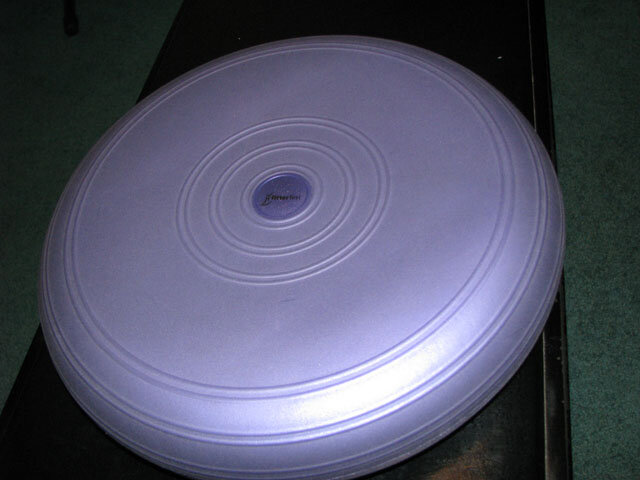

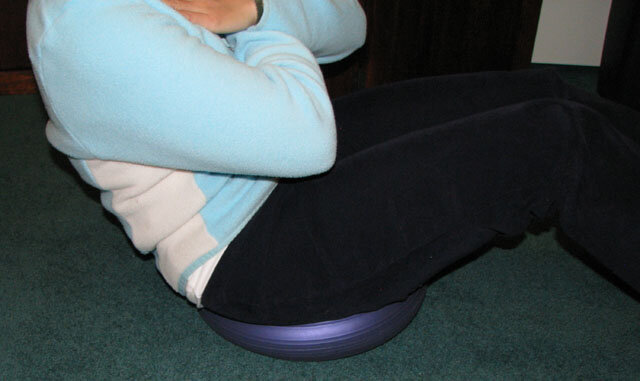
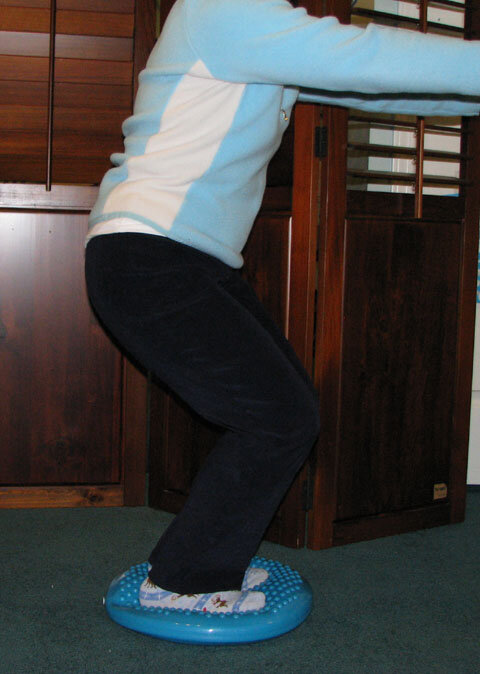
My three fidgety students used the disc as a foot cushion while using the FitBall Wedge as a seat cushion. Their feet didn't wander up and down keyboard stands, piano legs or wind up in the wastebasket as much when using the disc. Partway through a song, they simply stood on the cushion, shifting their weight in time to the music. This was the most successful application of the disc.
Fitter USA and Ball Dynamics International
The FitBall Seating Disc is manufactured by Fitter USA, part of Ball Dynamics International, LLC. BDI sells a variety of active sitting, resistance training, balance training aids and equipment.
It is a popular item on Amazon, ranking in the Top 40 of Amazon Best Sellers for Balance Trainers. For more information, read Exercise Ball Moves to the Office,and Product Review: FitBall Seating Wedge.
The FitBall Seating Disc is an affordable back pain remedy that fosters active sitting, core stability and posture correction. It is fun but use with care.
The FitBallSeating Disc is available at FitterFirst and Amazon.
Product Review: FitBall Wedge
On December 11, 2009, Fox News reported that a study conducted by the Institute for Medicine and Public Health found that people spend an average of 56 hours a week sitting. In "That's the Way the Ball Bounces!" from Working Well, it states that the average American spends 14 hours a day sitting.
Originally written for Suite101.com in November 2010. Another one that didn't survive "The Big Purge"
Do you suffer from back pain or poor posture? Sway, wiggle and squirm your way to correct posture and pain relief with the FitBall Wedge.
On December 11, 2009, Fox News reported that a study conducted by the Institute for Medicine and Public Health found that people spend an average of 56 hours a week sitting. In "That's the Way the Ball Bounces!" from Working Well, it states that the average American spends 14 hours a day sitting.
Even more alarming is the conclusion Genevieve Healy, Ph.D. from at the Cancer Prevention Research Centre after a conducting a study at the University of Queensland in Australia. She reports that not even 30 minutes a day at the gym can counteract the effects of sitting for eight, nine, or 10 hours a day.
Active sitting can relieve pain and fosters overall health. It is also known as "unsupported seating" and "sitting in motion." Active sitting encourages the body to move and adjust constantly. It also encourages the body to sit in a more natural position.
There are numerous benefits to active sitting, as stated by
, a supplier of active sitting devices:
improved core fitness: Continuous movement to re-stabilize your torso strengthens your spinal and abdominal muscles.
burn calories: You can burn up to 350 calories a day from active sitting.
improved balance: Active sitting is a form of balance training.
fosters natural body posture and alignment.
maintains blood flow.
What is the FitBall Wedge?
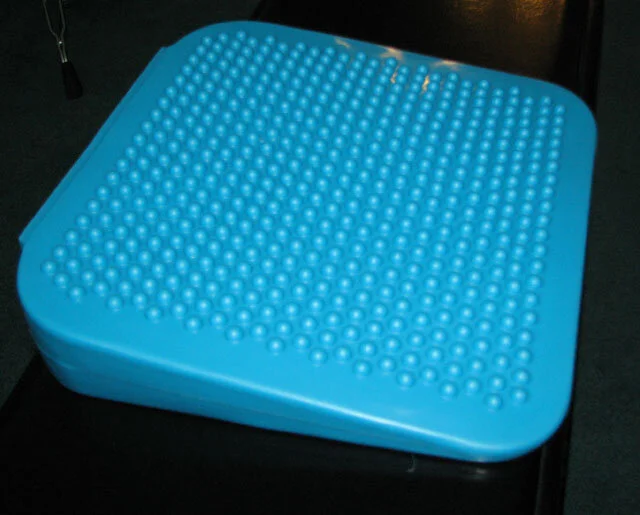
The FitBall Wedge is an active dynamic seating device. It is an 13" inflatable wedge made of PVC. One side is smooth while the other has sensory bumps. There is also a 10" FitBall Wedge Junior for children.
The FitBall Wedge can be placed on the seat of any office chair or task chair. While sitting with the FitBall Wedge, make sure that both feet are firmly on the floor. Bounce in your seat, move back and forth and from side to side to enjoy the benefits of active sitting.
Alternatively, you can place the FitBall Wedge on the back of a chair for extra lumbar support.
You can use an air mattress pump or air raft pump to inflate the FitBall Wedge. Beginners should start with more air in their FitBall Wedge until they have adjusted to active sitting.
Simply wipe down the FitBall Wedge with soap and water to clean it.
User Testing and Assessment of the FitBall Wedge
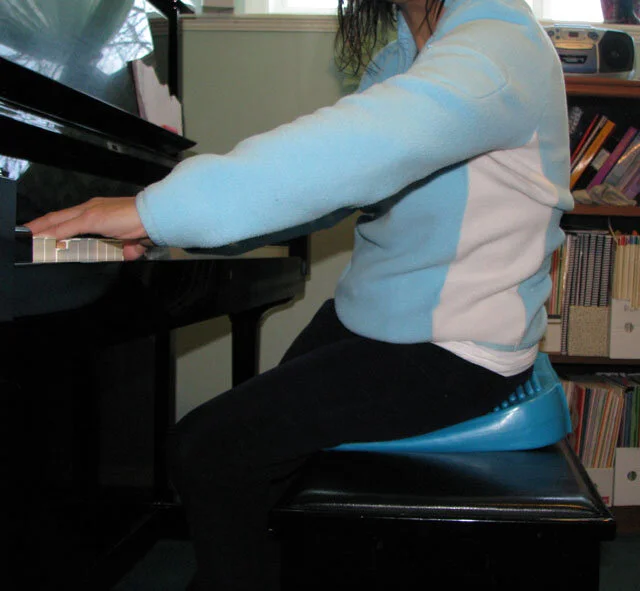


I purchased the FitBall Wedge one week ago to encourage my piano students to sit properly at the piano and to ease my own back pain.
My students, aged five to 50+, giggled over the new cushion and its bumps. "This is fun!" was a sentiment shared by most of my students just minutes into a lesson. My three fidgety students appeared more focused during their lessons. It helped that I placed another active seating disc at their feet. Each student who used the FitBall Wedge looked more relaxed at the piano bench and sat with proper posture. I have often noticed classically-trained pianists play with stiff posture and limited range of motion. My students were forced to move with the wedge, making their playing more natural looking, ergonomic and expressive.
I found the FitBall Wedge a back-saver. Between teaching and preparing for eight performances this month, I am at the piano over 30 hours a week and then sitting in front of a computer for at least an additional 10 hours a week. My back pain disappeared within minutes of sitting on the FitBall Wedge.
There are two minor drawbacks. The FitBall Wedge is available in only one colour. I also wish it could fit more easily into a bag full of music books. However, it still is more portable than a core stability ball.
As with any active sitting device, people with poor balance or who recently had back surgery should consult with a medical professional first prior to using the FitBall Wedge. If used improperly or with incorrect posture, the positive effects of active sitting can be nullified.
About the FitBall Wedge and Ball Dynamics International
The FitBall Wedge is manufactured by Ball Dynamics International LLC
It was founded Joanne Posner-Mayer, P.T., an expert on therapeutic Swiss Ball applications. It is available on Amazon. Locally, you may purchase it at Fitter First.
For more information, read "Sitting Too Much?" by Selene Yager, Women's Health Magazine, Exercise Ball Moves to the Office and Understanding Musician Injuries.
Social Media Links
archives
- #YYCArts 32
- #YYCEvents 39
- Collaborative Music 25
- Community 11
- Composing & Arranging 6
- Entertainment 139
- Entrepreneurship 53
- Freebies 3
- Gardening 1
- Geeking Out 65
- Health & Wellness 120
- Improvisation 25
- Interviews 28
- Learning Music 188
- Martial Arts 13
- Memorization 7
- Music 230
- Music Careers 9
- Music Education 196
- Music Examinations 7
- Music Exploration 55
- Music Gigs 14
- Music Lessons 6
- Music Performance 32
- Music Theory 13
- Musical Instruments 12
- Musician Health 19
- Pets 57
- Piano Technique 12
- Practicing Music 120
- Productivity 20
- Professional Development 11
- Recommendations & Reviews 93
- Recreation 71
- Social Media 6
- Spirituality 10
- Studio Management 33
- Studio Technology 50
- Teaching Music 146
FOLLOW THE STUDIO on Instagram



Affiliate Links
As a Sheetmusicplus and CD Japan affiliate, I earn from qualifying purchases. The earnings help fund the Studio’s blog and YouTube channels. Your support is greatly appreciated.


FOLLOW Budo no Tabi on Instagram