THE MUSICAL MUSE
Blog dedicated to music education, practice tips, health
&
wellness, and geeking out.
Music Practicing Tip - The Random Spot Drill
How well do you know your pieces? Try the Random Spot Drill to check.
For many music students around the world, this is a really tense time. There are only weeks before their music exam.
If you're preparing for a music exam, chances are your parents and your music teacher are telling you that you need to practice more, etc. etc.
This month, I'm checking to see how secure my students' repertoire is by using the Random Spot Drill. Really, it's as it sounds. You walk by the piano, sit down and try to play one of your pieces from anywhere. Well, from any memory station, that is.
If you're in the middle of your practice, try it for about a minute. Try playing the intro of one piece, the middle of another and the end of a third piece. OK, that's not really random, but you can make it random by trying any of the following:
Scribble out bar numbers onto slips of paper and put them in a jar or hat. Then number your pieces. Draw one slip to choose a piece and another to tell you which bar to start from.
Ask a family member in another room to pick a number from 1 and X (the last bar of your piece).
Get a random number generator app and have it choose your bar numbers.
Close your eyes and move a finger randomly on the score. When it stops, that's where you start.
Roll dice
Spin the Bottle
The idea behind the drill is to see how quickly you can get into the groove of that piece. After all, you never know when a distraction will occur. It could cause a blip. To keep you and your audience on track, you need to get back into the groove with as few missed beats as possible.
Making Use of Music Festival Comments
So you survived the music festival? Don't throw that adjudication sheet into recycling yet!
You have survived this season's run of music festivals and competitions. You have your certificate. Maybe you even earned an award.
Perhaps now you're asking yourself, "Now what?"
Please bring your written adjudication sheet(s) to your next music lesson. If your music teacher was unable to attend your music festival performance - and your parents recorded your performance - do bring the recording to your next music lesson to review with your teacher.
Your music teacher can help decipher the adjudicator's handwriting and discuss with you how to incorporate some of the ideas that you picked up at the music festival.
I put the word "some" in italics. Bear in mind that music is a personalized experience, not just for you but for the listener. Your adjudicator is giving comments based on their skills, experience and educated opinion based on your playing at that moment. You may agree with some comments, but not all. The same goes for your teacher.
Your music teacher, the adjudicator and the examiner have similar "hot buttons" that they listen for: rhythm, pedalling, fingering, balance, technical fluency, command of the style. In basic terms, they are listening for whether you know the piece and if you're telling us a story.
What will differ are some of the ideas that they each have for you to try. Each of your musical mentors have a different set of skills and experiences.
Take the ideas that each have to offer and try them. Give them a solid effort. Keep what works for what you're trying to say with the piece and file away the rest. Who knows? It may work with another piece better.
On Group Classes, Edutainment and Playful Learning
After five rounds of music group classes, it's time to reflect and review before I start planning for the upcoming year. Lots to mull over.
Another Group Class Week has come and gone. As I sit here trying to get my brain around next year, I'm mulling over how to approach group classes going forward.
Some students just aren't into group classes. While some like the idea of trying out something new (e.g. trying to make a radio commercial) but aren't really that interested in learning and honing their skills in those areas. Some like the ensembles. While some are just too busy for group classes and have missed every single one. You get the idea.
I know, we can't please everyone. To that end, I'm contemplating the idea of making the group classes optional and available to outside students.
Now, one comment that I usually hear from students and parents is how "X has so much fun at group classes." Well that's fine and dandy, but as an educator, I feel duty bound to teach them something. I'd like for them to learn something that will help them become better musicians and listeners.
The classes that they enjoyed the most weren't necessarily the ones where they actually learned anything. The aspiration of having the students create a video game theme, record, edit and then present it at the year-end recital? No dice. All the dreams of having them do a singing and accompanying project throughout the year and then perform it at the year-end recital? Nyet.
They fiddled, they made noise, they laughed a lot. Some made a 30-second radio commercial and saved a file. Others spent 90 minutes learning three types of beat patterns, while others played in a piano combo for the first time.
Is anything perform-able in public? Not without hours of tweaking (practice, editing, rendering and re-recording, etc.). Did they learn something that they can execute on their own? Uh-uh.
At least, they tried something new.
One area that started really slowly but gathered momentum was my Music Appreciation 101: Music & Technology class. It evolved each time a little bit to adjust to the next group of students. The students were fascinated with how music listening devices have evolved, especially with the addition of my retro-player:
Not only did this capture their attention, but the topic of copyright interested them too.
Now, the only group activity that saw any thread of progress and continuity was my student band WEDG as they prepared for the Long and McQuade Music Education Contest and later, the APTA Festival. That was an optional activity, which impacted only four students - profoundly enough that they are continuing to work together.
My challenge becomes one of creating group classes that will generate enough interest, yet from a pedagogical standpoint, teach them something useful. I've heard the term "edutainment" thrown around in relation to TV shows. However, that doesn't quite sit right with what I'm trying to do here. I suppose that "playful learning" or "learning through play" would be a closer fit. I suppose that really, they're just different terms on the same continuum of learning.
It's a lot of food for thought.
Music Degree Programs at Colleges and Universities in Alberta
An overview of the various post-secondary music degree programs and diploma programs available in Alberta, Canada at accredited colleges and universities.

Traditionally, a career in music centered around teaching and performance. Now, there is a growing number of careers in music, from recording arts to jazz and popular music. These seven colleges and universities in Alberta have responded to this development by offering diverse degree programs and diplomas in music.
From Bachelor to Doctorate of Music at the University of Alberta
Established in 1908, the University of Alberta boasts an enrolment of over 37,000 students (2009/10 figures). U of A has a well-recognized reputation worldwide. It's computing science program was ranked third in Canada and 55th in internationally in 2010, while its School of Business ranked 89th.
U of A offers three undergraduate music programs: Bachelor of Arts (Honours) with a Music Major, Bachelor of Music and, like the University of Lethbridge, a combined Bachelor of Music/Bachelor of Education. Students can major in composition/theory, history, performance or world music. The Faculty of Music also offers a post-degree in music.
Students gain invaluable ensemble-playing experience by joining one of U of A's 13-plus music ensembles. These range from the Wind Ensemble and Symphony Orchestra to the Madrigal Singers and the Indian Music Ensemble.
The University of Alberta also offers a Masters in Music, Masters in Arts (in Music) and Doctorate in Music. Graduate students can specialize in academics, applied music, choral conducting or composition.
A Music Degree and a Christian Education at Ambrose University College
Ambrose University College's history is rooted in several older post-secondary institutions, including the Canadian Nazarene College, the Canadian Theological College and the Alliance University College. Founded in 1921 as the Calgary Bible Institute, the institution focused on educating young adults to serve in the church or overseas missions. It received university accreditation in 1999 and in 2007, began operating as a single entity called Ambrose University College.
Located in Calgary, Alberta, AUC boasts one of the largest private academic libraries in Western Canada and has received a Government of Alberta Award for Educational Travel. With an enrollment just over 600, Ambrose's faculty-to-student ratio guarantees small classes.
Ambrose University College offers a four-year Bachelor of Music program, as well as a three- and a four-year Bachelor of Arts program (Music Major). Students receive lessons on their primary instrument, music theory, aural training and performance.
Students gain valuable ensemble experience by joining the Chamber Singers, College Singers, Community Singers, Chamber Orchestra, Jazz Ensemble, Brass Ensemble or Guitar Ensemble. The programs offer some flexibility in area of study as well as various leadership development opportunities (e.g. practicum and conducting).
Jazz and Contemporary Popular Music at MacEwan University
MacEwan University in Edmonton, Alberta, was founded in 1971 as Grant MacEwan College. The school has over 42,000 students. MacEwan U offers over 60 programs, including applied degrees, undergraduate degrees, certificates, continuing education, corporate training and diplomas. It 2009, MacEwan College became an accredited university.
In 2011, MacU unveiled a new Bachelor of Music in Jazz and Contemporary Popular Music program. It is the first post-secondary institution to offer a university degree that combines jazz and contemporary popular music. Students study basic techniques, history and music theory. They can focus on one or two of the following concentrations in their final two years of education: composition, performance, recording arts and comprehensive (combining two majors).
As with all music programs at the post-secondary level, students must participate and perform in a musical ensemble, such as the jazz ensemble, showcase band, jazz combo, jazz choir, guitar ensemble or percussion ensemble. The faculty also offers a two-year Music Diploma and four-year Bachelor of Music.
Study Classical and Jazz Music at Mount Royal University
Located in Calgary, AB, Mount Royal University was founded in 1911 as a college. Today, it boasts an enrollment of 14,000 credit students and offers bachelor’s degrees, applied degrees, university transfer courses, diplomas and certificates. MRC became MRU in 2009.
Mount Royal U offers two music performance diploma programs, the Classical Diploma and Jazz Diploma. Both streams focus on honing students' performance skills while providing a solid foundation in music history, theory, composition and improvisation.
There are several ensembles at Mount Royal including the Kantorei Choir, guitar ensembles, jazz combos, flute ensembles, percussion chorus and jazz vocal ensemble. The MRU Conservatory also has several youth ensembles. Many of its ensembles perform throughout western Canada. Distinguished alumni include opera singer Daniel Okulitch, the composer for the 2010 Olympic Winter Games, David Pierce and violinist Andrew Dawes.
As of April 2013, the MRU Jazz Program is one of the post-secondary programs on the chopping block in response to the drastic cuts to education in the Alberta 2013 budget. Efforts to save the program are well underway. Please visit Save our Fine Arts for updates.
Red Deer College's Music Diploma and Music Preparatory Program
Established in 1964, Red Deer College offers over 75 programs, including degrees, diplomas and university transfer programs. According to “Universities in Canada” on Study in Canada's website, Red Deer College has over 10,000 students enrolled.
RDC offers a two-year Diploma in Music that provides students a solid foundation in ear training, music history, music theory, performance ensembles, private music instruction and recording technology. Like MRU, students can concentrate on the classical stream or contemporary genres. They may also do a combination of both streams.
Red Deer is the only college in Alberta to offer a one-year preparatory program in Music, geared towards musicians with either little or no formal music training. Students learn the basics in listening, performing and composing music. After completing this program, students must audition into the diploma program.
Doctoral, Bachelor and Masters Degree Programs in Music at the University of Calgary
The University of Calgary is one of Canada’s top seven research universities in Canada. Established in 1966, U of C offers over 100 undergraduate, graduate and professional degrees and boasts an enrollment of over 29,000 students.
The University of Calgary Department of Music offers undergraduate and masters degree programs in Music. At the undergraduate level, students can enroll in the Bachelor of Arts (Music Major), Bachelor of Music (majoring in Composition, History and Theory of Performance) and a Bachelors of Music in Integrated Studies (combination of two disciplines).
Students can study composition, musicology, performance and telemedia arts in U of C's masters degree program. The U of C also offers a PhD program in Musicology or Composition.
The achievements of U of C's ensembles include touring throughout North America, airing on CBC Radio and performing at the Honens International Piano Competition and Festival. Notably, the Wind Ensemble has performed at the CBDNA National Conference and the World Association for Symphonic Bands and Ensembles (WASBE) Conference.
Digital Audio Arts and Combined Degrees in Music at the University of Lethbridge
Founded in 1967, the University of Lethbridge offers 150 undergraduate and graduate programs and serves nearly 7,000 students. This institution prides itself on its liberal arts education programs. Students can study a combined degree, graduating with two degrees within five years.
U of L offers several undergraduate music programs, including a four-year Bachelor in Music, B. Mus. in Digital Audio Arts, Bachelor of Arts (Music Major) or a Bachelor of Fine Arts (BFA). Students may also combine their music degree with another, such as a business management or education degree, in a five-year combined degree program.
Students can also enroll in a two- or three- year post-diploma B. Mus. Program. U of L's Masters Degree in Music and Master of Arts in Music is offered in voice, piano, collaborative piano, French horn, violin, conducing and composition.
Notably, University of Lethbridge's Bachelor of Music in Digital Audio Arts is the first degree program of its kind in western Canada. Its audio school combines academic courses with hands-on experience in first-class audio studios and labs.
Admission Requirements for Studying Music at the Post-Secondary Level
Music students not only need to meet the general admission requirements for university or college, but also the audition requirements to be accepted into a music program. Therefore, prospective students in music should speak with their music teacher and school guidance counselor as early as junior high to prepare.
A high level of performance is expected. The requirements differ from one instrument to another, but they are fairly similar when comparing music schools. For instance, at U of C, it is expected that pianists and vocalists be at Grade 10 (Royal Conservatory, Conservatory Canada or similar institution) or higher. Other instrumentalists should be at Grade 8 or higher.
Auditions are usually generally scheduled in the winter and spring. Alternatively, prospective students can submit their audition on DVD.
Music students have more options available to them at colleges and universities. Jazz and popular music, digital audio arts, music teaching and composition are just a few of the music programs available at universities and colleges in Alberta. Regardless of where a student plans to study music, he or she should thoroughly research various programs and admission requirements and speak with his or her guidance counselor and music teacher to ensure that all requirements will be met well before the audition.
Originally published April 2, 2011. Updated April 30, 2013. All rights reserved by Rhona-Mae Arca.
Summer Workshops for Music Teachers
One of these days, I'm going to sign up for a bunch of these summer workshops and courses for music teachers. Check out a handful that caught my eye. Perhaps I'll see you at one of these?
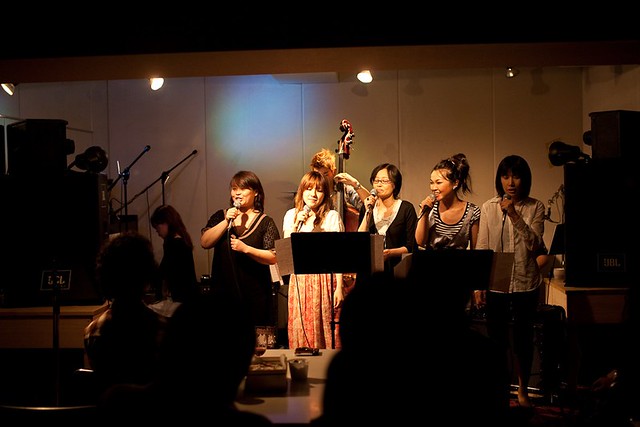
Our music teacher organizations and the Calgary Arts Summer School Association do a wonderful job at offering professional development opportunities for music teachers through workshops and conferences.
One thing I would like to get into more is to go away to study music teaching and performance. Here are some summer music programs for music teachers that caught my eye:
Adult Continuing Education Courses in Music at the Victoria Conservatory of Music
Boston University Summer Music Courses
Summer Workshops for Musicians and Music Teachers at MSU
Summer 2013 Workshops for Music Teachers at the University of Wisconsin
University of Delaware Workshops for Music Educators
University of Massachusetts Amherst Music and Drama Workshops and Courses
Video Conferencing and "Live" Music Technology and Jazz Education Workshops at Western State College
Social Media Links
archives
- #YYCArts 32
- #YYCEvents 39
- Collaborative Music 25
- Community 11
- Composing & Arranging 6
- Entertainment 139
- Entrepreneurship 53
- Freebies 3
- Gardening 1
- Geeking Out 65
- Health & Wellness 120
- Improvisation 25
- Interviews 28
- Learning Music 188
- Martial Arts 13
- Memorization 7
- Music 230
- Music Careers 9
- Music Education 196
- Music Examinations 7
- Music Exploration 55
- Music Gigs 14
- Music Lessons 6
- Music Performance 32
- Music Theory 13
- Musical Instruments 12
- Musician Health 19
- Pets 57
- Piano Technique 12
- Practicing Music 120
- Productivity 20
- Professional Development 11
- Recommendations & Reviews 93
- Recreation 71
- Social Media 6
- Spirituality 10
- Studio Management 33
- Studio Technology 50
- Teaching Music 146
FOLLOW THE STUDIO on Instagram


Affiliate Links
As a Sheetmusicplus and CD Japan affiliate, I earn from qualifying purchases. The earnings help fund the Studio’s blog and YouTube channels. Your support is greatly appreciated.


FOLLOW Budo no Tabi on Instagram